NAKED-EYE 3D LED DISPLAY GUIDE
Naked-Eye 3D LED Display Manufacturer for Corner Facades
A naked-eye 3D LED display manufacturer for a corner facade should be assessed on the physical display system, the accuracy of the proposed geometry, and the clarity of its responsibility boundary. Shenzhen MVPLED Technology Co., Ltd. develops and manufactures LED display systems in Shenzhen, China. Its project proposal should be checked against the building’s measured corner, viewing zone, installation interfaces, and the separate perspective-content workstream.
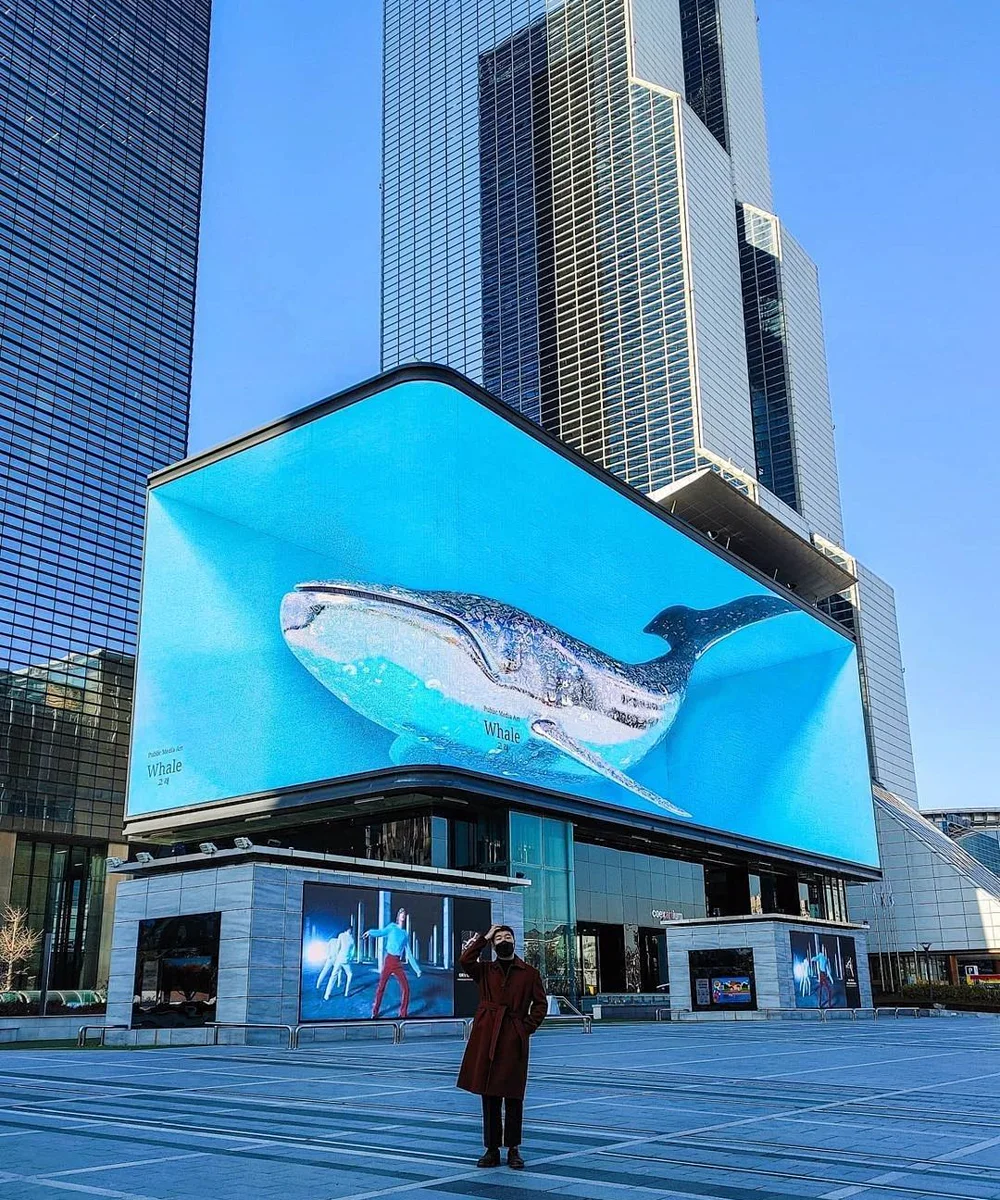
Buyers often start with an impressive video of a creature apparently leaving a building. That image establishes a creative goal; it does not identify the manufacturer, reveal the installed components, or prove that a different facade can use the same layout. A search for a corner LED display factory should begin with what the building can accommodate and which party must supply each piece of the finished experience.
What does a corner-facade manufacturer actually supply?
A corner-facade LED manufacturer supplies and configures the physical display system according to a project-specific proposal, rather than selling a universal 3D effect. For MVP LED, the customer or a content studio creates the perspective video to the final display dimensions and geometry supplied by the manufacturer. A buyer should request a dimensioned corner layout, a clear LED system and control boundary, power and signal assumptions, service-access information, and an itemized statement of inclusions and exclusions. Send the same measured facade drawings, viewing position, environmental conditions, and target display area to every shortlisted supplier. Ask who checks structure and installation, who owns the animation, and what data will be handed to the content creator. Compare returned evidence and scope before comparing prices. A project photograph or concept render can illustrate a format but cannot verify another site’s engineering, ownership, or commercial terms.
The approved MVP LED naked-eye 3D solution explains the hardware/content boundary. This supplier-selection article focuses on what a buyer should request from a manufacturer and what should remain an explicit project decision.
How can a buyer verify manufacturing relevance?
MVP LED’s documented production sequence includes SMT, module production and aging, cabinet assembly, system configuration, inspection, warehousing, and packing. These facts support a manufacturing discussion. They do not, on their own, establish that a particular building, animation, engineering approval, or installation belongs to MVP LED. Ask the prospective supplier to connect its proposed components to the actual drawings and explain which steps and checks apply to the quoted system.
For a corner installation, factory capability should be discussed in terms of controlled geometry and assembly, not just a photograph of a production line. Ask how the proposed display planes, edge transition, cabinet layout, service route, and system configuration will be documented. A credible response will say what is still unknown and which measured conditions must be confirmed before final selection.
Evidence that is useful in an initial supplier review
- A current company identity and product-family description that match the quotation.
- A proposed layout linked to the drawing revision supplied by the buyer.
- A component and control-scope schedule, with assumptions stated clearly.
- Examples of manufacturing and inspection steps relevant to the proposed LED system.
- Names of the parties responsible for structure, installation, content and operation.
Ask for direct answers to the project questions; do not infer an unverified certification, proprietary technology, or customer result from general marketing imagery.
Which site inputs change the proposed corner LED display?
Two buildings with equal nominal display area can require different layouts. The angle between facade planes, usable wall width, intended viewing point, access for maintenance, power routing, outdoor exposure, and local structural interfaces all change the technical discussion. The planned content matters as well because the virtual camera and mapped canvas must reflect the installed surfaces. Request a proposal tied to the actual building, not a catalogue screenshot with a different corner.
| إدخال المشتري | Why the manufacturer needs it | Decision to record |
|---|---|---|
| Measured facade drawings | Defines plane dimensions and corner relationship | Which drawing revision controls the proposal? |
| Primary viewing point | Connects the display geometry to the intended 3D illusion | Where will perspective be reviewed? |
| Structure and access | Sets interfaces for mounting and service | Who designs and approves the supporting work? |
| Power and signal route | Defines system handoff and site constraints | Where does supplier scope end? |
| Content ownership | Determines the video canvas and test handoff | Which studio creates and revises media? |
For other outdoor display formats, the outdoor LED display product page offers context. A 3D corner still requires its own geometry and responsibility review.
How is a 3D LED facade supplier different from a content studio?
The manufacturer is responsible for the physical LED system it agrees to supply and configure. A content studio creates the visual scene, perspective camera, animation, and mapped outputs it agrees to deliver. The buyer or appointed integrator coordinates those scopes with the building, installation, and operating teams. In MVP LED’s published solution description, the customer or content studio creates perspective video using final dimensions and geometry supplied by MVP LED.
The split matters commercially. If a proposal says “3D display,” ask whether that phrase refers to hardware suitable for a perspective video, an included animation, or a turnkey installed result. These are not interchangeable purchases. Record the deliverable, acceptance method, and revision responsibility for each. A sample video should never be treated as proof that a content license or creative service is included.
One handoff document for both teams
Request a versioned geometry sheet showing every plane, corner transition, pixel canvas, orientation, and target viewing point. The content studio can then prepare a concept and test media against that version. If the facade survey changes, the document and the content brief both change. This small control is more valuable than asking each party to interpret a different screenshot.
What should be in a 3D LED display quotation?
A useful 3D LED display quotation identifies the proposed display system, the measured basis for its geometry, the control scope, accessories and packing included, destination assumptions, and exclusions. It should name any buyer-supplied structure, site power, signal infrastructure, lifting or installation work, content creation, and permits or approvals where relevant. Ask the supplier to label provisional quantities and unresolved interfaces. That makes subsequent changes visible rather than surprising.
MVP LED states that published LED display price ranges are initial budgeting references, not fixed offers. Final itemized quotation depends on product configuration, quantity, accessories, packing, and destination. A corner facade adds questions about geometry and content coordination; a general price card is not enough to settle them. If you need a cost comparison, obtain the same scope categories from each bidder.
MOQ, lead time, production capacity, spare parts, and configuration vary by product and project requirements. The standard warranty baseline is two years, with final coverage defined by the signed quotation and contract. Ask what is covered in the specific proposal and which third-party work is excluded.
How should a US or European buyer shortlist manufacturers?
Use the same request package for each company: building location, dimensioned drawings, intended display area, viewing position, site photographs, operating pattern, access limits, environmental context, destination, and the party responsible for creative content. Ask each supplier to return a concise assumption list before it prices the project. That gives procurement a comparable basis and gives engineering a chance to catch an impossible geometry or missing interface early.
Then review how closely each response answers the actual site. Does the drawing match the supplied revision? Is the content handoff named? Are structural and installation boundaries explicit? Is service access considered? Are exclusions visible? A vendor that supplies a broad presentation without the requested scope may still be worth follow-up, but the unanswered items should remain open in the comparison sheet. Do not award a project on the apparent strength of a reference image alone.
Creative facade work may also intersect with creative LED display formats. Use that page to explore configuration possibilities, not to assume that one published example is available for every building.
الأسئلة المتداولة
Is every corner LED screen a naked-eye 3D display?
No. A corner screen is a physical format. The perceived 3D effect depends on perspective content designed for its geometry and viewing point.
Can a manufacturer quote from a video reference alone?
A reference can start a discussion, but a defensible project quote needs measured dimensions, site conditions, scope boundaries, and the intended content workflow. Ask which inputs remain provisional.
Does the manufacturer own the building structure or installation?
Do not assume so. The written proposal should distinguish LED system supply from structural design, mounting, local works, installation, permits, and operation.
Can the same animation be used on a different facade?
A concept may be adapted, but the mapped perspective file should follow the final display planes, pixel layout, and viewing position for the new site. Check creative rights and revision scope with the content owner.
Request a corner-facade manufacturer review
For a site-specific factory response, send MVP LED your corner-facade drawings and project requirements. Include the viewing location and identify your installer and content creator, if known. Ask for a clearly scoped physical-system proposal, content handoff data, assumptions, exclusions, and itemized commercial terms.
مراجعة المقال والمصادر
المؤلف: MVP LED Editorial Team, LED Display Product and Application Content. تمت المراجعة بواسطة: TOM, Product Manager. تاريخ المراجعة: November 5, 2026.
Sources: MVP LED 3D display solution and content boundary; MVP LED factory; quality control; warranty and services. Company and project-variable facts are retained in the editorial fact record.