
LED DISPLAY PROJECT GUIDE
Passenger Information LED Screen: Placement Brief
A passenger information LED screen belongs where a traveler can see and understand the next action without stopping in a circulation bottleneck. Mark the decision point, approach direction, reading distance, likely obstructions and message owner on a station plan before choosing display size or format. Then test a representative information layout from the actual viewing positions.
Placement is not simply a search for the largest empty wall. A board beyond the point where travelers must choose a route may be visible but too late to help. A bright visual on an approach may attract attention while carrying too many lines to read during movement. This brief gives station and airport teams a way to define the physical viewing task before requesting display hardware. It does not specify a passenger-information system or claim a particular terminal installation by MVP LED.
Where should a passenger information LED screen be placed?
Place a passenger information LED screen at a documented decision point, not merely at an available wall. Begin with the traveler route: entry, ticketing, transfer, security or platform approach, then mark where a passenger needs to identify a destination, time or instruction. Record the direction of travel, first visible position, practical reading zone and competing signs. Check columns, doors, queue structures and crowd build-up that may block the display. Ask the operator to rank the information that must be read first and identify the authorized content source. Test a representative message at the proposed scale from the priority positions before fixing screen dimensions. The building and systems teams should confirm mounting, power, signal and access. A manufacturer can review display format against that brief, but cannot validate a station-wide wayfinding scheme, live travel data or local approval simply from a product photo.
The station and airport LED display solution describes multiple transport-hub zones and formats. This article concentrates on the narrower placement question for passenger information. Advertising placement, content governance and source switching are separate decisions, and should not be treated as interchangeable with this screen’s reading task.
Which passenger positions deserve a sightline test?
Start at the places where a traveler first needs the information. For a platform approach, a person may need to choose a side before reaching the stairs or doors. In a terminal hall, the useful location might be where a route splits, not where the screen can fill the most architectural space. Map the first approach, the intended reading zone and the point after which an instruction arrives too late. Different routes can create different audiences for the same display.
Record standing and moving viewers separately. A person waiting in a queue can read more detail than someone crossing a concourse. A person emerging from a lift may have a shorter sightline than a traveler walking the main axis. The operator should identify priority users and messages; the display supplier should not infer them from a floor plan alone. The result is a placement brief that can be reviewed by the teams responsible for circulation and information.
Field observations to record on the drawing
- Approach arrows and the first position at which the display becomes visible.
- The exact choice the passenger must make after reading the message.
- Primary and secondary viewing positions, including waiting and moving viewers.
- Columns, ceiling drops, doors, temporary barriers and crowd lines that may obscure text.
- Existing signs and other screens competing for attention at the same point.
- Space for maintenance access without creating a new obstruction.
A photograph from the proposed viewer position can help the project team discuss the problem, but use a measured plan and elevation for the eventual hardware review. A camera lens can make a distant board look more legible than it appears in person. Keep the actual route and height information alongside any rendering.
How do station LED screen sightlines affect content?
A screen’s position and its content are one test. The operator should specify which fields have priority: for example, destination, platform, time or a short instruction where those are relevant. Do not invent or hard-code a universal message hierarchy for every transport operator. A proposed layout should show representative line lengths and changes, not a decorative city image standing in for operational data.
At the priority viewing location, test whether travelers can identify the required action within the available glance time. If the content is too dense, the answer may be shorter language, a different hierarchy, a second display or another position. Increasing physical screen area alone does not guarantee a readable message. The integrator and operator should check the actual content feed, update behavior and failure state in the final system.
For an airport passenger display location, note neighboring information that may have higher authority. A new LED surface should not obscure existing signs or make contradictory route cues. The operator remains responsible for message approvals and its wider wayfinding design. The manufacturer’s contribution is a project-specific physical display configuration and agreed interfaces.
What changes when passengers move through the zone?
Transit LED viewing zones can be brief and uneven. A traveler approaching from one direction may have several seconds of visibility; another may see the display only after turning. Observe normal flow, peak crowding and queuing where possible. Describe the difference to the project team instead of using one nominal viewing-distance number to stand for every user. The best hardware response depends on which position the owner treats as critical.
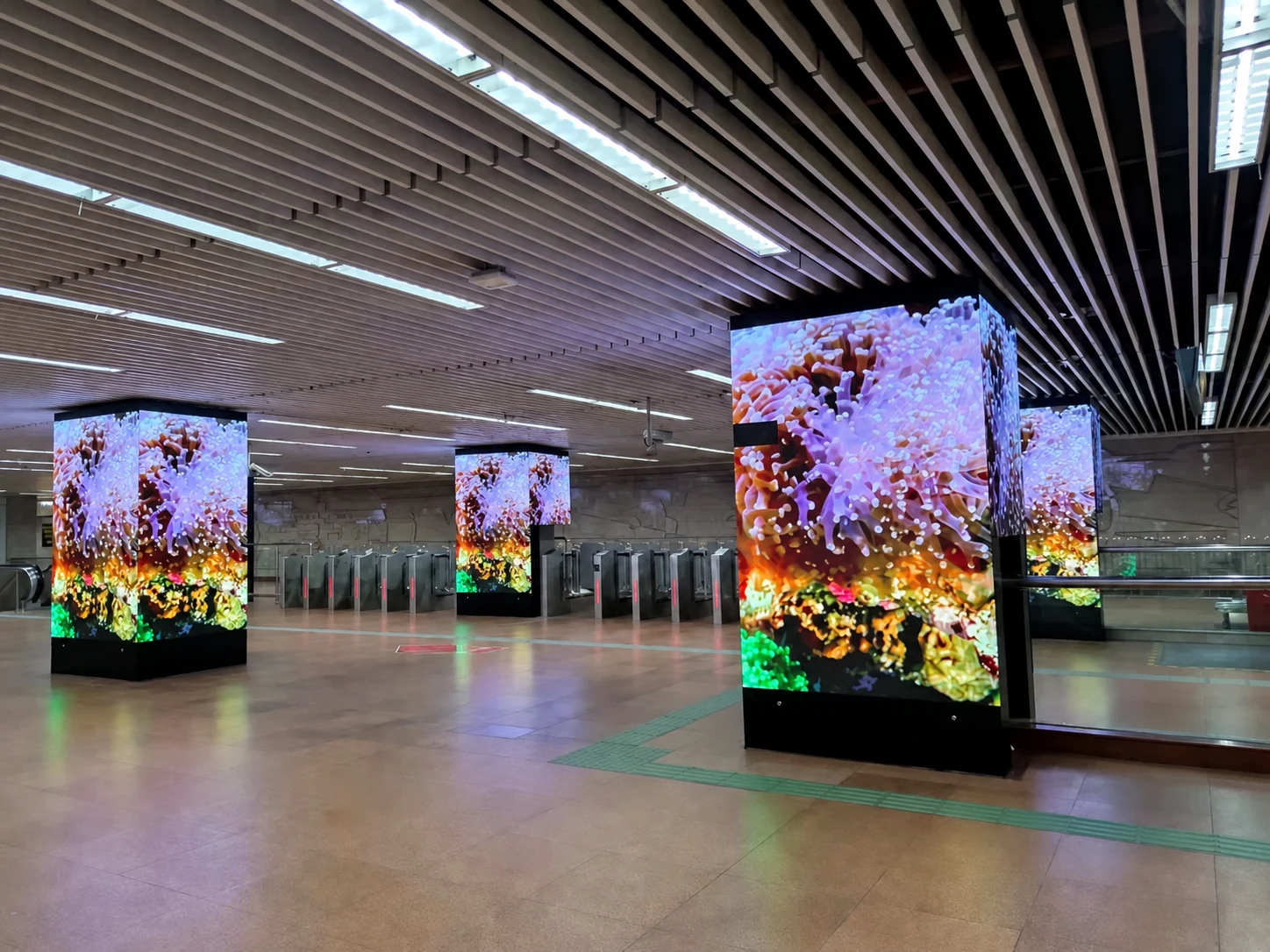
Consider the full height and width of the readable field. A low display may be hidden behind a queue; a high one may be difficult to read from nearby. Architectural columns can create attractive mounting positions but divide the viewing field. A portrait-format LED poster display may suit a local message near a waiting point, while a larger indoor LED display may support a broader hall view. These are format references, not promises that either one fits an unmeasured site.
Passenger safety and circulation decisions belong to the venue and its qualified design teams. Do not allow a proposed screen or its service route to narrow an essential path based only on a marketing sketch. Ask the responsible party to review temporary barriers during installation and future service as well as the permanent cabinet location.
| Placement question | Evidence to request | Decision owner |
|---|---|---|
| When is the information needed? | Route map and decision point | Operator and wayfinding team |
| Who can read it? | Viewing photos, measured positions and mock content | Operator and project designer |
| What blocks the view? | Plan, elevation and crowd observations | Building and operations teams |
| What carries the content? | Source, owner, update and priority plan | Operator and systems integrator |
| How is it maintained? | Access route and service direction | Installer, operator and display supplier |
The table is a briefing tool, not a substitute for site design. It exposes questions that should be answered before a manufacturer fixes the layout or the buyer compares prices.
What should be sent to a display manufacturer?
Send a dimensioned plan and elevation identifying the proposed screen zone. Include the approach routes, priority positions, expected content canvas, ambient-light description, mounting concept, available power and signal path, service direction and destination. State which measurements are verified and which are provisional. A supplier should mark assumptions rather than transform a conceptual location into a final specification without review.
Shenzhen MVPLED Technology Co., Ltd. develops and manufactures LED display systems in Shenzhen, China. Its approved production record covers SMT, module production and aging, cabinet assembly, system configuration, inspection, warehousing and packing. Those facts explain the manufacturer’s physical-system role; they do not establish ownership of passenger data, station approvals or local installation. A project quote should state what the LED supplier includes and what remains with the operator, building team or integrator.
Ask for a display layout tied to the drawing revision, proposed product family, active area, system and control boundary, service direction, packing and destination basis. MOQ, lead time, spare parts and configuration depend on the product and project. The standard warranty baseline is two years; actual coverage follows the signed quotation and contract. None of these general facts can replace a site-specific sightline review.
Frequently Asked Questions
Can a passenger-information screen be placed wherever a wall is available?
No. Test the route, decision point, actual viewing position, obstructions, content and service access before confirming the location. Available wall area is only one input.
Is a larger LED wall always easier for travelers to read?
No. Message length, hierarchy, position, distance and viewing time matter. Test representative content from priority positions before committing to a size.
Who approves the information shown on the screen?
The station or airport operator and its authorized information team define the content and update workflow. A hardware supplier does not create authority over passenger data.
Does the article image show an MVP LED airport contract?
No. The approved station-context image illustrates a possible display setting; it is not proof of an MVP LED customer project or airport approval.
Request a placement review
For a passenger information LED screen discussion, send MVP LED your station plan, elevations and passenger-flow points. Name the message owner and the decision a traveler must make. Ask for a physical display response that states its scope and open integration questions.
Article Review and Sources
Author: MVP LED Editorial Team, LED Display Product and Application Content. Reviewed by: TOM, Product Manager. Review date: November 16, 2026.
Sources: MVP LED station and airport solution; factory role; warranty terms. Placement advice is editorial guidance for project briefing, not a claim about a completed transit installation.