
LED DISPLAY PROJECT GUIDE
Wayfinding vs Advertising LED Displays for Transit Hubs
Wayfinding vs advertising LED displays is primarily a content and operating distinction, not a universal hardware split. Passenger information must serve a specific travel task under the transport operator’s control; commercial media follows a separate campaign and approval workflow. Define the audience, message owner, update source, placement and service plan for each display zone before choosing a wall, poster unit or other LED format.
A terminal or station may use several LED surfaces that look alike from a distance. One helps a traveler find a gate, platform or service point; another sells media near a retail area. Combining both into one brief without defining priority and control can cause the wrong information to appear at the wrong moment. This comparison helps buyers write a clearer display-system request. It does not assert compliance with any airport or rail standard, and it does not claim a specific existing transit contract.
What separates wayfinding vs advertising LED displays?
Wayfinding and advertising LED displays differ first in message purpose, content owner and update workflow. A transit wayfinding LED screen is intended to help passengers make a travel decision, so the operator or authorized information team must define the source, priority, update method and readable location. An airport advertising LED wall carries commercial content controlled through a separate approval and scheduling process. The same physical LED product family might be configured for either task, but its placement, canvas, sources, switching and acceptance tests should follow the chosen workflow. A station passenger display near a decision point may need concise directions, while a commercial wall can support broader visual storytelling where it does not interfere with operational information. The buyer should identify each zone, priority viewer, responsible operator, content system, service access and integration boundary. MVP LED can propose physical display formats, but the terminal’s information governance and local requirements remain with responsible parties.
The MVP LED station and airport solution distinguishes passenger-facing information from commercial media. The article below turns that distinction into a procurement and placement framework, rather than treating every public screen as interchangeable advertising space.
Who owns the message and its accuracy?
For wayfinding, the operator or authorized information team decides what directions or service messages are correct and when they change. A display supplier can specify a screen and control interfaces; it cannot decide the terminal’s gate data, platform updates or emergency communication rules on its own. Ask the integrator which source systems feed the display and how an approved change reaches passengers. If the information is static, record who updates it when the building changes.
For commercial media, the advertising or retail team may manage campaigns, scheduling, creative approval and proof of play. That does not automatically give it authority over operational content. If a surface is shared, write down priority, switching and the person who can override a commercial playlist. Do not leave these decisions to a generic media-player setting discovered during installation.
Content ownership questions
- Who approves each message type and who can change it?
- What system or person supplies updates?
- How quickly must a changed message appear for the intended task?
- Can the surface carry more than one class of content?
- Who tests the displayed result and documents an error?
These are operational inputs for the display specification. The answers vary by owner and site; no manufacturer page can predefine them for every terminal.
Where should a transit wayfinding LED screen be placed?
A passenger-information screen should be positioned where a traveler needs the message. Mark entrances, check-in or ticketing points, junctions, platforms and waiting areas on the actual plan. For each candidate zone, identify approach direction, closest useful viewing distance, obstructions, competing signs and the time available to read. A large wall placed far from a decision point may be visually prominent but less useful than a smaller, well-positioned information display.
Test the message at a normal walking speed as well as from a waiting position. The content owner should decide which words and numbers must be read at each point. The display supplier can then review active area, layout and brightness conditions. Do not pick a pixel pitch or numerical type size from a generic article; verify the selected system and actual viewing context with a test file.
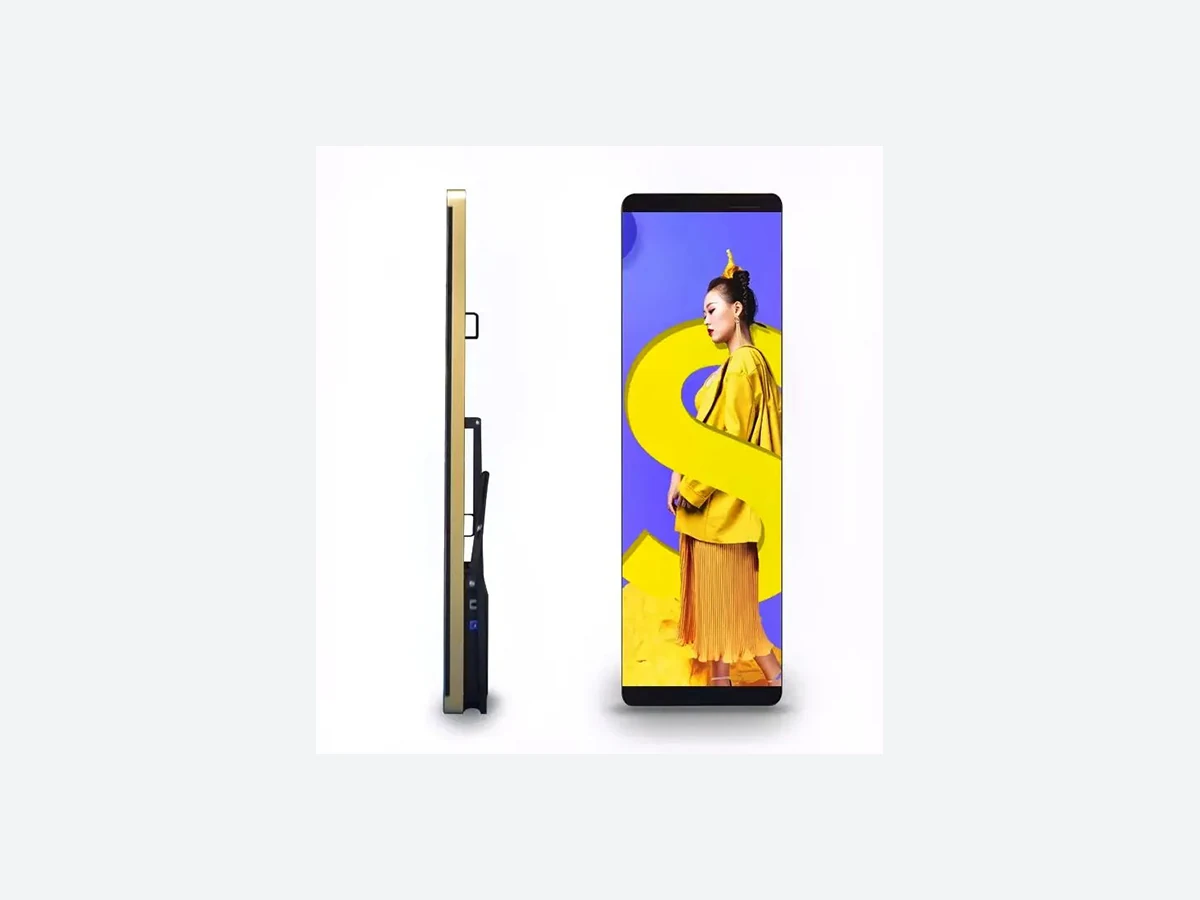
An LED poster display is a portrait-format product reference that may be considered for certain entrances or queues. The image shown here is a product-format illustration with commercial fashion content, not an airport installation or evidence that advertising should replace official passenger information.
Where does commercial LED media fit?
Commercial displays can be considered near retail, concourses, waiting areas or architectural features where they support the space without obscuring essential information. The advertising team should define the intended audience, dwell time, campaign format, scheduling and content rights. The building and operator teams should confirm sightlines, access, power, installation boundaries and any restrictions. A campaign wall has a different success measure from a directional notice, even if both use a fixed indoor LED display.
A commercial surface can use more detailed visuals, but the actual content still needs to be legible from its priority positions. A wall in a fast-moving corridor may be seen briefly; a display beside a waiting area may invite longer attention. Use the visitor journey and operating rules rather than assuming the largest available wall is the best advertising location.
Can one screen carry both passenger and advertising content?
It may be possible to plan separate zones or switch sources, but the terminal operator and integrator must approve the workflow. Define which content has priority, how the switch occurs, whether it is manual or scheduled, and who tests recovery after a source failure. The LED supplier should receive the required input and control interfaces, not an undefined request for “both.” A dual-use screen needs a documented pixel layout and acceptance test for each mode.
| Decision | Passenger information | Commercial media |
|---|---|---|
| Primary purpose | Help a traveler make a specific decision | Communicate a campaign or brand message |
| Content owner | Operator or authorized information team | Commercial or advertising team |
| Update trigger | Operational change or service schedule | Campaign schedule or approval |
| Placement test | Readability at a decision point | Visibility to the target audience |
| Integration test | Correct source and priority | Correct playlist and allowed timing |
The table does not establish regulatory compliance or a universal rule that commercial content may appear in every terminal zone. It is a way to ask the owner and integrator for a clear project-specific operating decision.
How should the display hardware be selected?
After the content and zone are defined, the supplier can review a fixed wall, poster-format unit, architectural column or other appropriate product family. The MVP LED transport-hub solution presents these as format and configuration references. Screen dimensions, viewing distance, ambient light, mounting depth, power, data, service direction and operating schedule still need a site-specific review. A product photograph does not prove it has been installed in a particular airport.
Shenzhen MVPLED Technology Co., Ltd. develops and manufactures LED display systems in Shenzhen, China. Its approved process evidence covers SMT, module production and aging, cabinet assembly, system configuration, inspection, warehousing and packing. Those facts support a hardware-supplier role. The responsible owner must supply content governance, systems integration and local approvals, unless a written contract assigns additional work. MOQ, lead time, spare parts and configuration vary by project, and final warranty coverage is defined by the signed quotation and contract against a two-year standard baseline.
What should a buyer include in a project brief?
For each zone, mark its location on a plan and state whether the screen serves wayfinding, passenger service, advertising or another defined purpose. Provide the priority viewer position, dimensions, mounting concept, indoor or exposed conditions, service route and operating schedule. Name the content owner and source system. If two workflows share a screen, attach a switching and priority concept for the integrator to review.
Request a display-system response with active area, format, control boundary, power and signal interfaces, service method, destination and exclusions. Ask the operator to verify the message and the integrator to verify source behavior. This is more useful than a single request for an “airport LED wall” that leaves its actual job undefined.
Frequently Asked Questions
Can an advertising screen also show wayfinding?
It can be proposed as a dual-use system only if the operator approves content priority, sources, switching, placement and acceptance testing. Do not assume it from hardware capability alone.
Is a poster-format LED unit an airport passenger display by default?
No. It is a product format. The operator must define the message, site, content system and responsibilities before it becomes part of a passenger-information workflow.
Who sets rules for official travel information?
The responsible terminal or station operator and its authorized information teams do. A display manufacturer supplies project-specific hardware and interfaces under the written proposal.
What should be tested before accepting a shared screen?
Test each content source, the displayed canvas, switching and priority behavior, readable positions, recovery from a source problem and the route for updating content.
Start with the content owner, then the screen
If you are comparing wayfinding vs advertising LED displays, send MVP LED your transit-hub plan and zone-specific content brief. Identify who operates each message type and where passengers or customers will view it. Request a physical-system proposal that names the control interfaces and remaining integration questions.
Article Review and Sources
Author: MVP LED Editorial Team, LED Display Product and Application Content. Reviewed by: TOM, Product Manager. Review date: November 16, 2026.
Sources: MVP LED station and airport content-zone guidance; manufacturer role; warranty terms. Company and project-variable facts are retained in the editorial fact register.